Key takeaways
- First-time credit card applicants (with "NH" or no CIBIL history) should prioritize lifetime free cards with straightforward cashback and zero hidden fees.
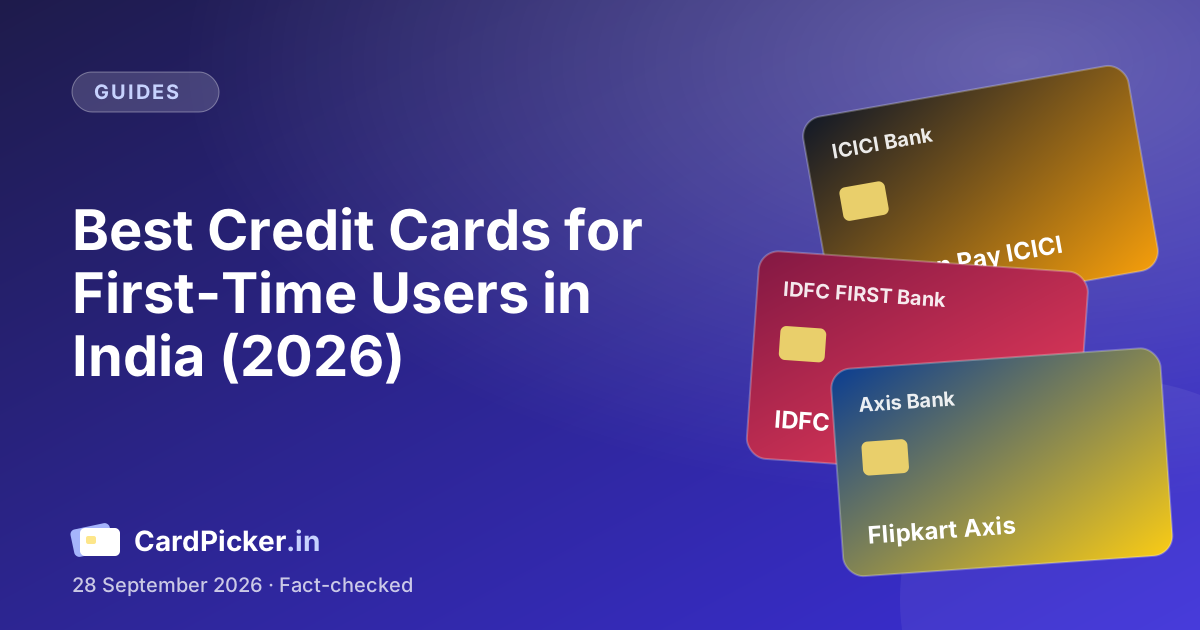
- Top starter cards include Amazon Pay ICICI (lifetime free), IDFC FIRST Millennia (lifetime free), and Flipkart Axis Bank.
- Always pay 100% of your Total Amount Due on time; paying only Minimum Amount Due (MAD) triggers 42%+ annual interest.
- Using between 10% and 30% of your credit limit builds a 750+ credit score within 6 months, unlocking premium cards later.
Getting your very first credit card is an exciting financial milestone. Used responsibly, a credit card provides an interest-free 45-to-50-day credit window, earns you 1% to 5% cashback on everyday purchases, offers fraud protection, and builds the credit history required for future home and auto loans. Used carelessly, however, high revolving interest (up to 45% p.a.) and late fees can quickly derail your financial health.
For your first credit card, you want a product that is simple, low-cost (preferably lifetime free), transparent, and easy to manage.
What Banks Look for in First-Time Applicants
When you have no existing CIBIL record (your score shows as "NH" for No History or "-1"), banks assess your application based on alternative stability metrics:
- Age & Employment: Must be at least 21 years old and employed with a registered private/public company or government body.
- Salary Stability: Consistent monthly salary credits for at least 3 to 6 consecutive months.
- Banking Relationship: Existing savings account balance, fixed deposits, or salary account track record.
- Digital KYC: Aadhaar-linked mobile number for instant paperless e-KYC.
Top 3 First Credit Cards for Beginners
1. Amazon Pay ICICI Credit Card (The Gold Standard Starter Card)
Amazon Pay ICICI Bank
Lifetime free · No fee to waive · Forex 1.99%
- Lifetime free, with no joining or annual fee
- 5% back on Amazon for Prime members
- 2% back on bill payments through Amazon Pay
Watch out: Only 3% on Amazon without Prime
The Amazon Pay ICICI Bank is the most recommended first card in India because it has zero joining fee, zero annual renewal fee, and zero reward redemption charges. You never have to worry about spending enough to waive fees. It gives unlimited 5% cashback on Amazon for Prime members, 2% on bill payments, and 1% offline, credited straight into your Amazon Pay wallet monthly.
2. IDFC FIRST Millennia Credit Card (Best Feature-Rich Starter)
IDFC FIRST Millennia
Lifetime free · No fee to waive · Forex 0%
- Lifetime free
- Zero forex markup on international spends (from September 2026)
- 10X reward points on spends above ₹20,000 a month
Watch out: Low base reward rate after the January 2026 cut
IDFC FIRST Millennia is another 100% lifetime free option that comes with premium perks usually reserved for higher-tier cards: dynamic interest rates (9% to 36% p.a. vs 42%+ on other banks), complimentary railway lounge access, zero forex markup, and reward points that never expire.
3. Flipkart Axis Bank Credit Card (Best for Active Shoppers)
Flipkart Axis Bank
₹500 + GST · Waived on ₹3,50,000 yearly spend · Forex 3.5%
- 5% cashback on Flipkart and 7.5% on Myntra
- 4% cashback on preferred partners like Swiggy, Uber and PVR
- 1% unlimited cashback elsewhere
Watch out: Fee waiver needs ₹3.5 lakh yearly spend
If you shop frequently on Flipkart, Myntra, Swiggy, and Uber, the Flipkart Axis Bank delivers unmatched value at just ₹500/year (which is easily offset by its welcome benefits). It gives flat 5% cashback on Flipkart and 4% on Swiggy and Uber, credited directly to your monthly statement.
Starter Cards Side-by-Side Comparison
| Feature | Amazon Pay ICICI Bank | IDFC FIRST Millennia | Flipkart Axis Bank |
|---|---|---|---|
| Card | Amazon Pay ICICI BankICICI Bank | IDFC FIRST MillenniaIDFC FIRST Bank | Flipkart Axis BankAxis Bank |
| Annual fee | Free | Free | ₹500 + GST |
| Joining fee | Free | Free | ₹500 + GST |
| Fee waiver | No fee to waive | No fee to waive | Waived on ₹3,50,000 yearly spend |
| Network | Visa | Visa | Visa / Mastercard |
| Amazon rewards | 5% | 0.38% | 1% |
| Flipkart rewards | 1% | 0.38% | 5% |
| Other online shopping rewards | 1% | 0.38% | 1% |
| Food delivery rewards | 1% | 0.38% | 4% |
| Dining out rewards | 1% | 0.38% | 1% |
| Groceries rewards | 1% | 0.38% | 1% |
| Flights & hotels rewards | 1% | 0.38% | 4% |
| Fuel rewards | 0% | 0% | 0% |
| Bills & recharges rewards | 2% | 0.13% | 0% |
| Everything else rewards | 1% | 0.38% | 1% |
| Forex markup | 1.99% | 0% | 3.5% |
| Lounge access | None | Railway lounge access | None |
| Reward caps | No major caps | 10X points (1.25%) on monthly spends above ₹20,000 | Flipkart cashback capped at ₹4,000 per quarter |
| Est. yearly value: balanced spender | ₹5,400 | ₹1,995 | ₹6,360 |
| Est. yearly value: online shopper | ₹7,980 | ₹2,505 | ₹7,860 |
| Est. yearly value: frequent traveller | ₹6,782 | ₹6,195 | ₹12,684 |
| Est. yearly value: family & groceries | ₹7,920 | ₹3,690 | ₹6,960 |
| Best for | Amazon Prime members who want a no-fee card | Young professionals who want a no-fee card with zero forex markup | Regular Flipkart and Myntra shoppers |
| Pros |
|
|
|
| Cons |
|
|
|
| Visit ICICI Bank | Visit IDFC FIRST Bank | Visit Axis Bank |
The 4 Golden Rules for Your First Credit Card
- Always Pay the "Total Amount Due", Never the "Minimum Amount Due": The Minimum Amount Due (usually 5% of your bill) is a trap. Paying only MAD prevents late fees but triggers full revolving interest (around 3.5% per month or 42%+ per year) on your entire balance, including new purchases. Set up auto-debit for 100% of your bill. See our guide on Minimum Amount Due explained.
- Keep Utilization Between 10% and 30%: If your starting limit is ₹50,000, try not to let your statement balance exceed ₹15,000. High utilization signals credit hunger to credit bureaus and lowers your score. Check with our credit utilization calculator.
- Never Withdraw Cash from an ATM: Using a credit card at an ATM incurs a Cash Advance Fee (₹300 to ₹500) plus immediate interest from day one with zero grace period. Read our cash withdrawal guide.
- Understand Your Billing Cycle: Your statement is generated on a fixed date each month, with a due date 15 to 20 days later. Making large purchases right after your statement generation date gives you up to 50 days of interest-free credit. Learn how with our statement guide.
How Your First Card Builds a 750+ CIBIL Score
Credit bureaus (CIBIL, Experian, Equifax, CRIF High Mark) assign 35% of your credit score weight to payment history and 30% to credit utilization. By making 100% on-time payments and maintaining low utilization for 6 to 9 consecutive months, your score will rapidly rise to 760–800, qualifying you for premier cards like SBI Card Cashback and HDFC Bank Millennia.
Read our in-depth tutorial on how to improve your CIBIL score using a credit card.
FAQs
Can I get a credit card without a job or salary?
If you do not have a salary, you can get a secured credit card against a fixed deposit (from ₹5,000) or an add-on card linked to a family member's account.
Does checking my credit card eligibility hurt my CIBIL score?
Checking pre-approved offers on banking apps is a "Soft Enquiry" and does not impact your score. Submitting a formal application triggers a "Hard Enquiry", which can temporarily lower your score by a few points.
What is the interest-free grace period on a first credit card?
The interest-free period ranges from 20 to 50 days depending on when you make the transaction during your billing cycle. It applies ONLY if you pay your previous statement balance in full by the due date.
Sources
- CIBIL: Understanding Credit Scores and First-Time Borrowers
- RBI: Master Direction on credit and debit cards
- IDFC FIRST Bank: FIRST Millennia Credit Card
- Axis Bank: Flipkart Axis Bank Credit Card Terms