Key takeaways
- Standard Indian credit cards charge an exorbitant 3.5% foreign currency markup + 18% GST (total ~4.13% fee) on every Thai Baht (THB) and UAE Dirham (AED) swipe.
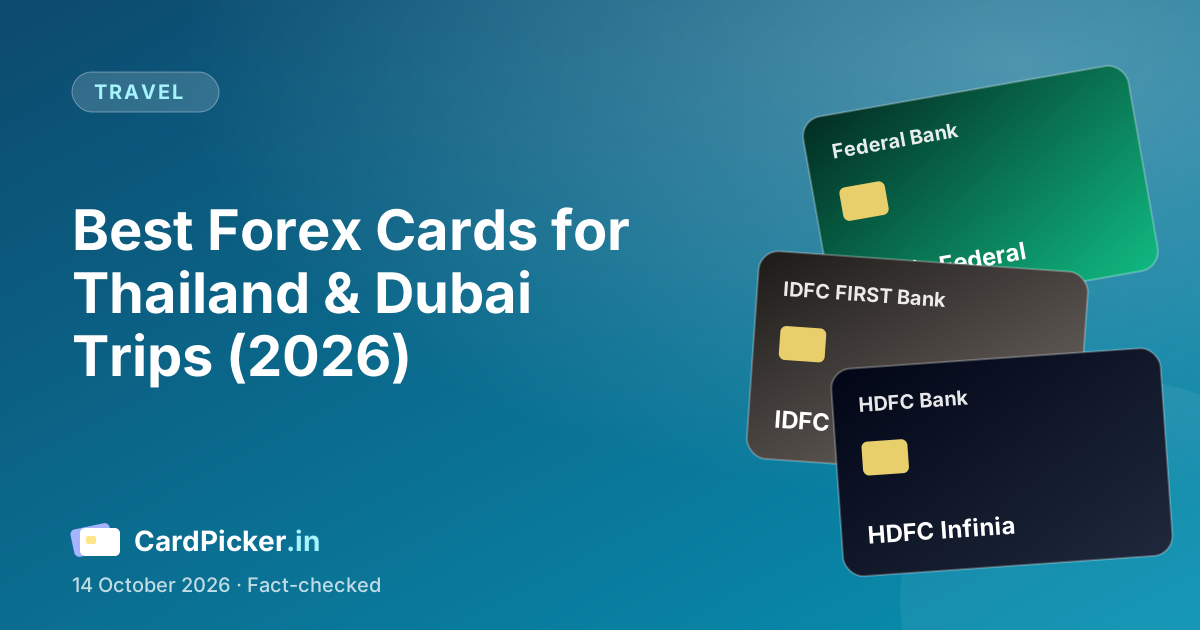
- Zero forex markup credit cards (like Scapia Federal Bank and IDFC FIRST Wealth) eliminate conversion markups completely, saving ₹4,130 on every ₹1,00,000 spent.
- In Thailand, local ATM operators (Bangkok Bank, SCB, Krungsri) levy a mandatory flat 220 THB (approx. ₹550) fee per cash withdrawal on all foreign cards.
- Always choose to be billed in local currency (THB in Thailand, AED in Dubai) to avoid the predatory 3% to 5% Dynamic Currency Conversion (DCC) markup trap.
Thailand and Dubai (United Arab Emirates) consistently rank as the top two international holiday destinations for Indian tourists. Whether you are exploring the night markets of Bangkok, relaxing in Phuket, shopping at the Dubai Mall, or embarking on a desert safari, managing international payments efficiently is the key to protecting your holiday budget.
Unfortunately, most Indian travelers casually swipe their domestic credit or debit cards abroad, unaware that traditional Indian banks levy a punitive 3.5% foreign currency markup plus 18% GST—costing an effective 4.13% in hidden fees on every single transaction. On a family vacation budget of ₹3,00,000, you throw away over ₹12,000 on administrative banking charges! In this 2026 guide, we compare zero forex credit cards against multi-currency prepaid forex cards and reveal the essential payment strategies for Thailand and Dubai.
1. Zero Forex Credit Cards vs Prepaid Forex Cards: The Showdown
Indian international travelers generally choose between two primary card mechanisms:
| Comparison Factor | Zero Forex Credit Cards (Scapia / IDFC) | Prepaid Multi-Currency Forex Cards |
|---|---|---|
| Foreign Currency Markup | 0.00% (Zero Forex) | 0% on loaded base currencies; 2.5%–3.5% cross-currency |
| Exchange Rate Applied | Live interbank Visa/Mastercard exchange rate | Locked-in rate set by issuing bank at loading |
| Pre-Trip Currency Loading? | No pre-funding needed (spends from credit line) | Must remit INR upfront before travel |
| Leftover Funds Handling | Zero friction (no unused foreign currency) | Must pay unloading / encashment fees to get INR back |
| ATM Cash Withdrawals | Cash advance fee + interest (Not ideal for cash) | Flat ATM withdrawal fee ($2 to $3 per withdrawal) |
| Rewards Earned Abroad | Full travel coins / reward points earned | 0% Rewards or cashback |
2. Thailand Travel Guide: Navigating Thai Baht (THB) & ATM Fees
Thailand remains a heavily cash-reliant economy for local street food stalls, tuk-tuks, long-tail boats, and traditional night markets, while upscale shopping malls (Siam Paragon, CentralWorld), hotels, and chain restaurants gladly accept card payments.
The 220 THB ATM Operator Surcharge Trap:
Whenever you insert a foreign credit or debit card into any ATM in Thailand (operated by Bangkok Bank, Kasikornbank, Siam Commercial Bank, or Krungsri):
- The Thai ATM operator imposes a mandatory, non-negotiable fee of 220 Thai Baht (approx. ₹550) per withdrawal, regardless of your card's issuing bank!
- The Strategy: Minimize the number of ATM visits. Rather than withdrawing 2,000 THB multiple times, make a single large withdrawal of 10,000 to 20,000 THB at an official bank branch ATM to dilute the impact of the flat 220 THB fee.
- Card Swipes: For all hotels, major restaurants, shopping malls, and supermarkets (7-Eleven, Big C), swipe your Scapia Federal Bank to pay 0% markup and earn travel rewards.
3. Dubai & UAE Travel Guide: The Cashless Wonderland (AED)
In contrast to Thailand, Dubai is virtually 100% cashless. From Dubai Metro tickets and RTA city taxis to local supermarkets, shawarma shops, and high-end boutiques, contactless card payments and mobile tap-to-pay are accepted everywhere.
- Zero Need for Large Cash Reserves: You can complete an entire week-long holiday in Dubai without withdrawing a single UAE Dirham in cash. Keep less than 200 AED in cash for incidental tips.
- RTA Taxi Payments: Every municipal taxi in Dubai features an integrated credit card terminal supporting contactless Tap & Pay at zero extra charge.
- Duty Free Purchases: Dubai International Airport (DXB) duty-free stores process transactions smoothly with zero forex cards.
4. The Deadly Dynamic Currency Conversion (DCC) Trap Abroad
Whether in Phuket or Dubai, whenever an overseas card machine or hotel POS terminal detects an Indian card, the screen will present a seductive question:
"Transaction Amount: 4,000 THB. Would you like to be billed in INR (₹10,450) or THB (4,000)?"
NEVER CHOOSE INR! ALWAYS SELECT THE LOCAL CURRENCY (THB in Thailand, AED in Dubai)!
When you select INR abroad, the foreign merchant applies Dynamic Currency Conversion (DCC) at an inflated exchange rate (typically 3% to 5% worse than market rates). Furthermore, the Reserve Bank of India and Indian banks levy an extra 1% + 18% GST DCC fee on overseas transactions processed in Indian Rupees! Paying in the local foreign currency with a zero-forex card guarantees pure interbank conversion rates.
5. The Winning Two-Card Strategy for Southeast Asia & Middle East
- Primary Card (All Swipes & Tap-to-Pay): The Scapia Federal Bank. It is 100% Lifetime Free, charges 0.00% forex markup, and earns accelerated Scapia Coins on all global spending.
- Secondary Backup Card: The IDFC FIRST Wealth (also lifetime free with 0% forex markup and complimentary international airport lounge access).
- Emergency Cash Source: Carry a small reserve of cash (approx. $100 to $200 USD in clean banknotes or ₹10,000 worth of foreign currency purchased before departure from an authorized Indian forex dealer) to exchange at airport counters for initial taxi fare.
FAQs
Why do ATMs in Thailand charge a 220 THB fee on foreign credit cards?
The 220 Thai Baht fee is a mandatory local ATM operator surcharge levied by Thai commercial banks on all international cards. It is completely independent of your Indian bank and cannot be waived.
Should I choose INR or AED when paying by card in Dubai?
Always choose AED (United Arab Emirates Dirham). Choosing INR triggers Dynamic Currency Conversion (DCC), which adds an inflated 3% to 5% exchange rate markup plus an additional 1% + GST bank fee.
Can I use the Scapia credit card to pay for local taxis in Dubai?
Yes. All Dubai RTA taxis accept international contactless credit cards. Paying with Scapia incurs zero foreign exchange markup fees at exact interbank rates.
Sources
- Federal Bank Scapia Credit Card Terms
- RBI Foreign Exchange Management Regulations Master Direction
- CardExpress 2026 Travel Card Changelog